- Infinite White Space
- Posts
- Essentialism Vs. Maximalism
Essentialism Vs. Maximalism
Or, How can I possibly steer this ship, when it's powered by ten distracted octopi, all of whom are just as confused as me about where we're going

Andrea Blythe
February 26, 2026
Ever since I started pursuing a career in writing, I’ve felt pulled in a many different directions. I may have started out trying to write and finish a novel (hasn’t yet happened yet), but quickly found myself exploring short stories and poetry. What about screenplays? Yeah, that sounds fun. How about blogging? Yep, throw that in there, too. Making YT videos? That’s neat.
At any given point, I’ve had several projects going at once, with a over dozen other projects started and patiently waiting for me to return to them to finish one day (and I always intend to finish them one day). Faced with these multitude of possibilities, it was — and continues to be — difficult to know what I should be focusing on at any given time. Not to mention that attempting to pursue so many different pathways often leaves me feeling like I haven’t made any progress at all.
It was with this in mind that I picked up Essentialism: The Disciplined Pursuit of Less by Greg McKeown, which advocates for stringently cutting out everything from your life except the most essential. The idea is to achieve a state of doing “less but better”, or in other words figuring out what we’re the most inspired by, talented at, and meets a need in the world, so that we can focus on doing work that provides "our highest level of contribution: the right thing the right way at the right time.”
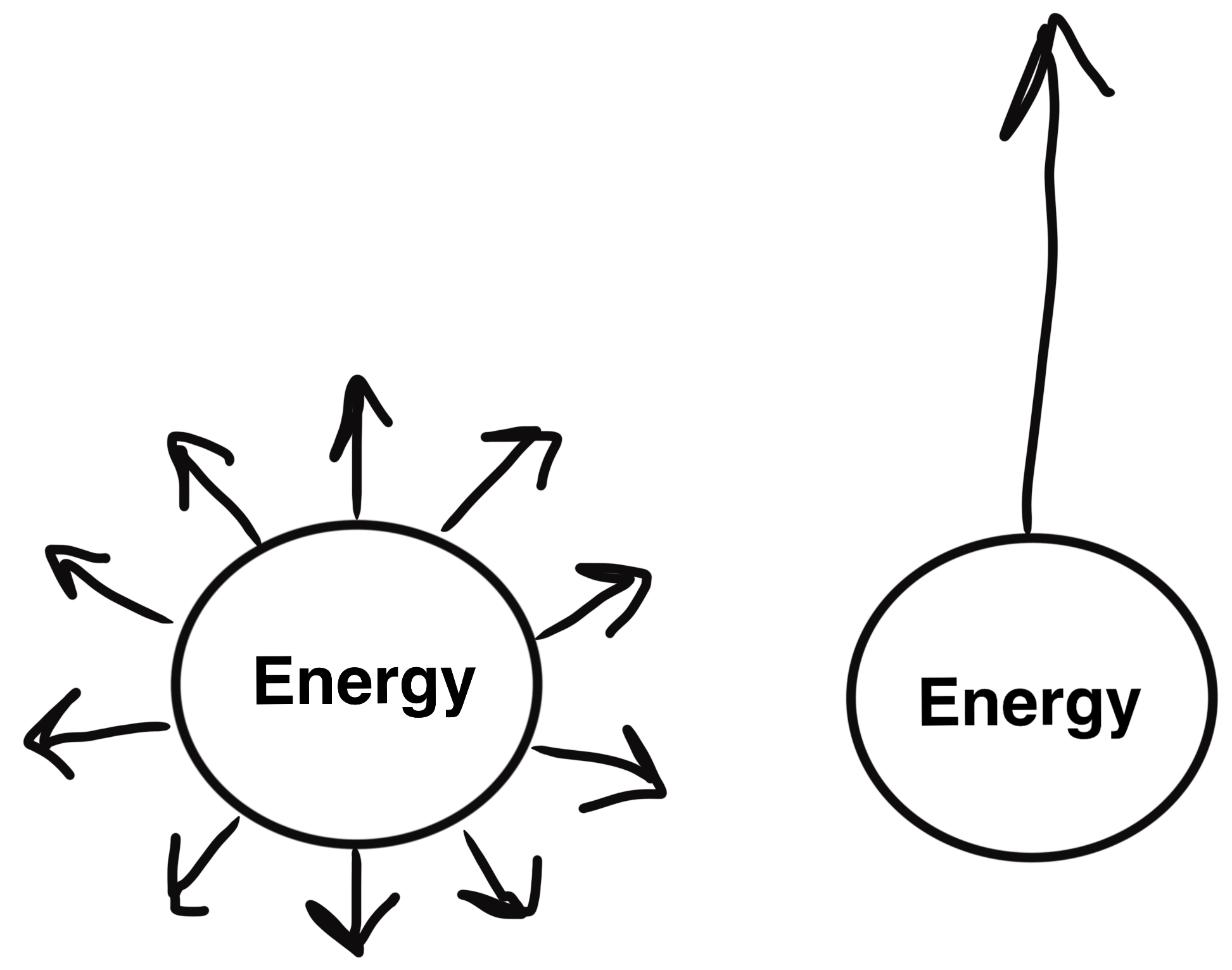
A recreation of one of the visuals from McKeown’s Essentialism, showing how spreading your energy and time out into many different directions doesn’t allow you to achieve forward momentum the way moving toward a single purpose does. (Guess which one has been me my whole creative life?)
McKeown presents a number of methods to figure out what is essential in your life, including exploring the possibilities to discern what's vital, eliminating the trivial, and removing obstacles and distractions to improve the execution of your projects and goals. There's a lot of great advice in here, including methods for analyzing particular paths or projects to make intentional decisions regarding how to spend your time and energy.
“Making our criteria both selective and explicit,” notes McKeown, "affords us a systematic tool for discerning what is essential and filtering out the things that are not.”
It’s an approach I find interesting, considering my multitude of projects over the years and tendency to want to work on everything at once, which often leads to nothing getting finished. One of the great lessons I’ve learned as a writer and creative is that in order to make progress, you have to finish things and then share them with others (either among your collective of fellow creatives, via social media, or via publishing). So, I see the immediate value in just making a conscious choice to finish one specific thing and then move forward onto the next.
However, I'm a little put off by the way McKeown sets up a dichotomy between the essential and nonessential, as if one is clearly good and the other obviously bad.
Not to mention that McKeown’s approach requires a certain amount of priviledge in certain scenarios. The ability to drop everything else and simply focus on your one singular passion requires a certain financial stability not available to everyone. Sometimes you have to chase a multitude of side work just to earn enough funds to make rent and buy groceries at the end month — passions be damned.
In a way this discussion reminds me of the discourse surrounding minimalism, which grew out of the popularity of Marie Kondo’s The Life-Changing Magic of Tidying Up. The minimalist movement was focused on the elimination of things to achieve a greater happiness, similar to McKeown’s “less but better” approach. By getting rid of lots of stuff and replacing it with a few high quality items, the person in question would feel less burdened.
However, similar issues surrounding privilege apply. The ability to own only a few “high quality” items, as advocated by minimalism, runs into the Boots Theory, which explains an aspect of socioeconomic disparity. Namely, the wealthy are able to buy a single pair of expensive boots that can last five years, while the poor can only afford to buy cheaper boots that break down quickly, resulting in them buying more boots (and spending more money) over the same period of time.

Minimalism versus maximalism in interior design. (Photos by Prydumano Design and Steph Wilson on Unsplash)
Aesthetically, a direct counter point to minimalism is maximalism, which involves a degree of the ornate, with rooms full of color, detail, tchotchkes, and art. It's a vibrant form of decor, bordering on the overwhelming or cluttered. I imagine that this style stems from a desire to collect, to fill your life with things you love, and a desire to openly display the things you love, so that you can see and enjoy them in your every day life. It’s a style that can be built over time, by slowly searching for and gathering objects that fit your space.
Both minimalism and maximalism represent the extremes regarding home aesthetics —neither of which is right or wrong. But the reality is that most people live somewhere in a space between, filling their home with an amount of objects, art, and family photographs to make the space feel comfortable to them.*
Austin Kleon, poet, artist, and author of Steal Like an Artist, points out the value of clutter and messiness, noting that in an artist’s studio such clutter can lead to insights and inspiration that might not otherwise be discovered:
This might be a good time to mention that while The Life-Changing Magic of Tidying Up can work wonders on your sock drawer or your kitchen pantry, I have serious doubts about its usefulness to artists and creative people. Some of my favorite artists not only have messy studios, they have intentionally messy studios, because they understand that creativity is about connections, and connections are not made by siloing everything off into its own space. New ideas are formed by interesting juxtapositions, and interesting juxtapositions happen when things are out of place.
I resonate deeply with this sentiment. My personal taste leans toward maximalism — both in terms of interior design and my creative pursuits. I want to line my walls with art and books, and I also want to create all the things.
All of my creativity feeds all of my other creativity. I love experimentation and trying out new forms of writing, sketching, and creative work, everything from poetry to collage art, to game design and screenwriting. Similar to the messy studios Kleon praises, this exploration and experimentation of a multitude of forms allows me to discover new juxtapositions and spark new ideas.
And yet, there's a point where this abundance overwhelms me. Too much clutter in my home and creative space makes it difficult to focus, and I need to clear the space in order to sit down and work. Too many ideas or projects at once makes it difficult for me to know where to put my attention, and I need to make careful choices about what to work on, so I can actually finish things and get them out into the world.
One of my issues with having a multitude of ideas and projects has less to do with the amount of projects and more to do with how I've been making choices about what to focus on. In a way, I’ve been swinging from project to project out of a sense of desperation — a need to grow my career, so I can earn more money.
Capitalism… yay.
I've been known to chase projects for the idea (if not the reality) of short term financial gain, just because the bills are feeling overwhelming at the moment. (An excellent example of this is the way I created and launched Patreon account at the end of last year in the wake of holiday spending, despite the fact that I don’t have the energy to take on the management of such an account and attempting to do so is not a good use of my time.)
That’s where McKeown’s lessons on essentialism could benefit me. I need a method to make intentional decisions about my creative work — rather than jumping at ideas out of some sense of obligation or financial desperation — so that I can work on things I love, finish those things, and see actual progress in my career as a creative.
So, I'm adapting the idea of the essential to my personal pursuit the Year of Games, with bit of a twist. My primary focus of “Games” includes a number of offshoots and methods to progress toward that overall goal. This includes making games (both individually and with other game designers), as well as avenues for learning (books, workshops, etc), writing about games (essays, critique, reviews, etc.), and building community (events, social media, etc.).

My Year of Games, which makes space for different pathways to movie toward my primary goal, as well as allowing for other forms of creativity that can help feed my work in games.
It’s also important for me to leave space for other forms of creativity, so I have arrows for “Poetry" and “Other Creativities.” This fulfills my overall need for general creative work, allowing for the kinds of exploration, experimentation, and creative play that spark my imagination and feed my soul.
In turn, this non-game work can come around and end up serving as inspiration for the games I'm working on. For example, several of game ideas I’m currently noodling are heavily inspired by poetic language and form.
In the end, there's a lot of testing and assessing involved in figuring out a path that works for you, whether it's an essentialist approach of one thing at a time or a more maximalist approach of trying all the things. It remains to be seen whether my modified approach will yield the results I want. All I can do is try, see where I end up, and then go from there.
Where do you fall on the scale? Are you more of an essentialist or a maximalist when it comes to your creative pursuits?
*I feel as though Kondo (at least as she presents herself on the Netflix show Tidying Up) is more aligned with this sentiment. Although she advocates for decluttering and tidying up, she also seems pleased when people embrace the things they love.
What I’ve Been Working On
I finally finished “Princess Tower,” an itsy Bitsy adventure game about climbing a tower to rescue a princess. It was intended to be a super simple game that I could complete in a short amount of time — and then I made it more complicated than it needed to be — and then I forgot to save the files properly, so I lost a ton of work — and the Bitsy tool completely broke for some reason and I had to switch to a different browser (and recreate another set of lost work) — and now it’s finally finished, and you can play it for free in your browser.
For Once Upon the Weird, I shared a few thoughts on on Iron Lung’s blood-soaked cosmic horror, the question of whether its success could open doors for more indie filmmakers, and the trend of indie horror game adaptations.
My interview with Erika T Wurth, in which we discuss hauntings, history, and her new book The Haunting of Room 904 is up at Interstellar Flight Magazine.

On a personal note, I spent the last week up at my sisters house in the mountains. The storm was heavy, dumping over four feet of snow in just a few days, causing branches and trees to collapse — one of which fell between the house and my car. After clearing the snow and branches, it was revealed that the rear window was broken, some snow and dampness had gotten inside the car, and the side mirror was busted, as well as there being several dents and lots of scratches.
It may be fixable, and I’ve contacted my insurance. A portion of my energy will be on figuring this out. But it’s a blessing that the damage wasn’t worse.
Thank you for reading and spending a little of your precious time with me! If you’d like to support my work, you can subscribe for free or, if you are a generous soul, you can buy me a coffee.
I make games! You can play some of them for free on Itch. If you’re a game developer looking for a writer or narrative designer, please check out my portfolio.
I also write poetry! Find my books here.
Reply